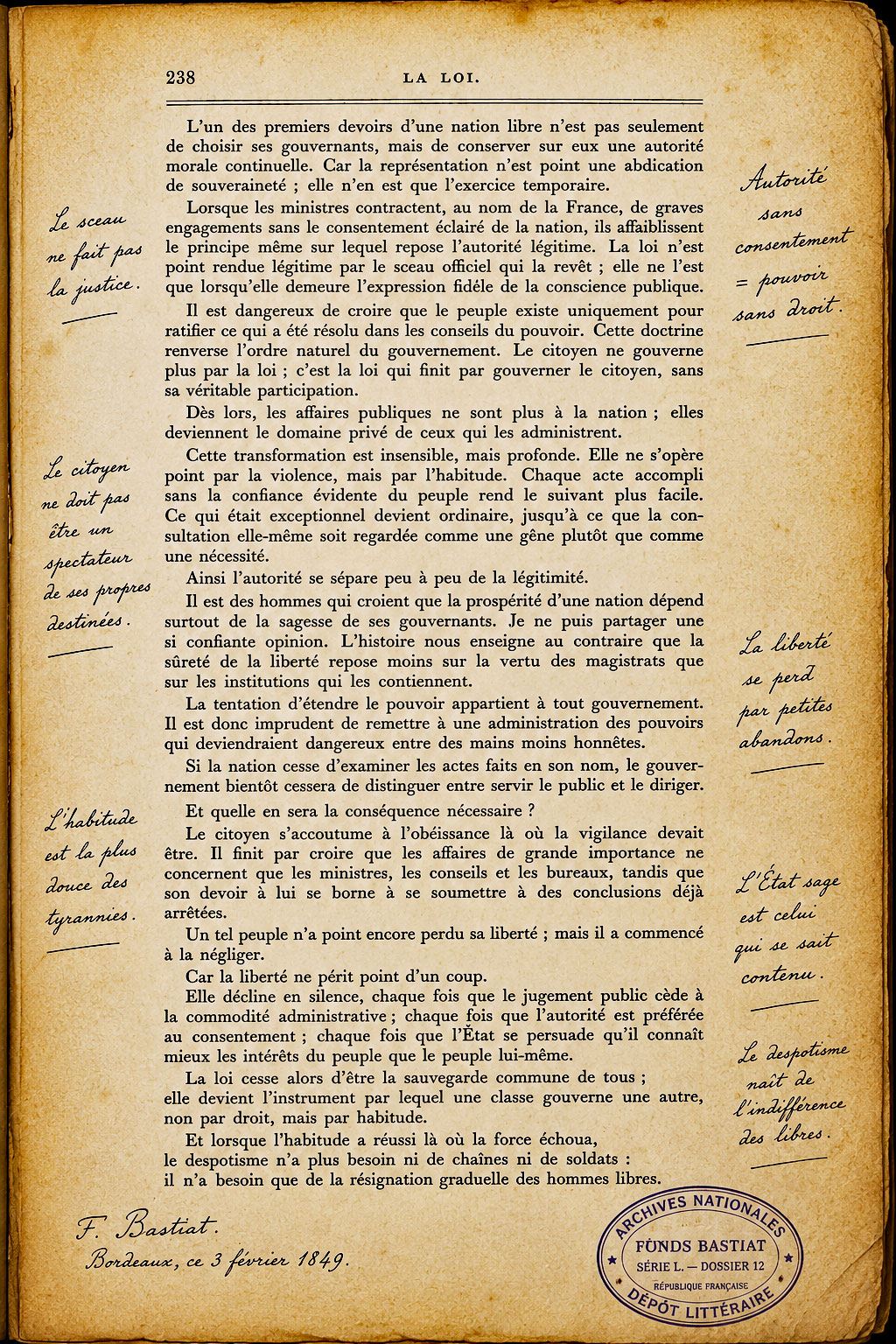
One of the first duties of a free nation is not merely to appoint its rulers, but to preserve over them a continual moral authority. For representation is not a surrender of sovereignty; it is only the temporary exercise of it.
When ministers undertake grave engagements in the name of France without the enlightened assent of the nation, they weaken the very foundation upon which lawful authority rests. The law is not made legitimate because it bears an official seal; it is legitimate only insofar as it remains the faithful expression of the public conscience.
It is dangerous to imagine that the people exist merely to ratify what has already been resolved in the councils of power. Such a doctrine reverses the proper order of government. The citizen no longer governs through the law; rather, the law comes to govern the citizen without his true participation.
From that moment, public affairs cease to belong to the nation and become the private province of those who administer them.
This transformation is subtle, yet profound. It is accomplished not by violence, but by habit. Each act performed without the evident confidence of the people makes the next act easier. What was once exceptional gradually becomes ordinary, until consultation itself is regarded as an inconvenience rather than a necessity.
Thus, authority separates itself from legitimacy.
There are those who suppose that the prosperity of a nation depends chiefly upon the wisdom of its rulers. I cannot share such confidence. History teaches instead that the security of liberty rests less upon the virtue of magistrates than upon the institutions that restrain them.
The temptation to enlarge power belongs to every government. It is therefore imprudent to entrust any administration with powers that would become dangerous in less honorable hands.
If the nation ceases to examine the acts performed in its name, the government will soon cease to distinguish between serving the public and directing it.
And what is the inevitable consequence?
The citizen grows accustomed to obedience where vigilance was required.
He begins to believe that affairs of great importance belong only to ministers, councils, and bureaux, while his own duty is merely to submit to conclusions already reached.
Such a people has not yet lost its liberty—but it has begun to neglect it.
For liberty rarely disappears in a single decree.
It declines quietly, each time public judgment yields to administrative convenience; each time authority is preferred to consent; each time the State persuades itself that it understands the interests of the people better than the people themselves.
The law then ceases to be the common safeguard of all.
It becomes the instrument through which one class governs another, not by right, but by habit.
And when habit succeeds where force once failed, despotism requires neither chains nor soldiers.
It requires only the gradual resignation of free men.